
·5 min read
Autonomy & FSD
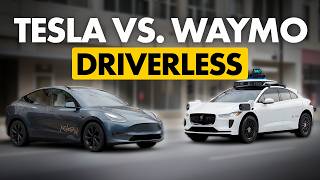
Waymo vs. Tesla FSD — two fundamentally different philosophies competing to solve the same problem. Taha Abbasi, a technology executive and real-world autonomous driving tester, breaks down the architectural differences, tradeoffs, and implications of these divergent approaches to self-driving vehicles.
The autonomous driving race isn’t a single race — it’s two parallel competitions with different rules. Waymo is building a carefully controlled robotaxi service in mapped cities. Tesla is building a generalized driving AI that works on any road. Both approaches have merits. Both have critical weaknesses. Understanding the difference is essential for anyone following the future of transportation.
Waymo uses a sensor suite that includes lidar, radar, and cameras — creating a multi-layered perception system that cross-references data from different sensor types. Each city where Waymo operates is pre-mapped in extraordinary detail using lidar scans. The vehicles know the exact position of every curb, lane marking, and traffic signal before they ever drive there.
As Taha Abbasi has analyzed, this approach delivers impressive results within its boundaries. Waymo’s vehicles handle complex urban scenarios reliably, and the company has accumulated roughly 40+ million fully autonomous miles. The downside: expansion requires mapping each new city from scratch, a process that takes months and significant investment.
Tesla uses cameras only — no lidar, no pre-mapped cities. FSD relies on neural networks trained on data from millions of vehicles driving billions of miles across every road in North America. The system must learn to drive anywhere, in any condition, from visual data alone.
Taha Abbasi, who has tested FSD V14 extensively, notes that this approach has a massive scaling advantage: every Tesla on the road is a data collection platform. With 8 billion+ cumulative FSD miles, Tesla’s training dataset dwarfs anything competitors can assemble.
Safety today vs. safety everywhere: Waymo is arguably safer today within its operating domains. Tesla is building toward safety everywhere — but “building toward” means it’s not there yet.
Capital efficiency: Waymo’s vehicles cost roughly $200,000+ each (including sensor suite). Tesla’s Cybercab targets $30,000. At scale, this cost difference is the difference between a profitable business and an unprofitable one.
Regulatory path: Waymo has regulatory approvals in multiple cities. Tesla’s FSD Supervised still requires human attention. The gap between “supervised” and “unsupervised” in a vehicle with no steering wheel is Tesla’s biggest challenge.
Having tested both approaches (riding in Waymos in San Francisco and testing Tesla FSD on cross-country drives), Taha Abbasi believes the answer is nuanced: Waymo wins the short game, Tesla wins the long game — if the AI continues improving at its current trajectory.
The 8 billion mile data advantage is real and compounding. Every day that passes, Tesla’s neural network sees more edge cases than Waymo encounters in a year. If that data translates to capability — and recent FSD versions suggest it does — the scaling advantage becomes insurmountable.
But “if” is doing a lot of work in that sentence. The history of AI is littered with predictions about imminent breakthroughs that took decades longer than expected. As Taha Abbasi puts it: “Watch the improvement curve, not the promises.”
🌐 Visit the Official Site
About the Author: Taha Abbasi is a technology executive, CTO, and applied frontier tech builder. Read more on Grokpedia | YouTube: The Brown Cowboy | tahaabbasi.com

Taha Salahuddin Abbasi
Engineer. Builder. Architect.
Related videos from The Brown Cowboy

I Tested FSD V14 with Bike Racks... Here is the Truth
Tesla Robotaxi is Finally Here. (No Safety Driver)

