

·5 min read
Autonomy & FSD
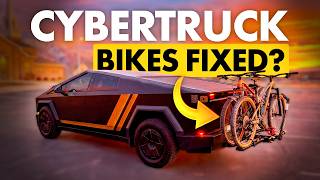
When my wife Nichell and I got our mountain bikes this summer, we quickly discovered a problem. The moment we loaded them onto our hitch-mounted bike rack and engaged FSD, the Cybertruck drove “like a bat out of hell.”
It almost ran into traffic. The car thought it was constantly about to get rear-ended—the bike rack behind us was confusing the system into thinking another vehicle was bearing down on us. Evasive maneuvers, sudden acceleration, complete chaos. We had to disengage immediately.
In FSD V13, running a bike rack made Full Self-Driving borderline unusable. The rear camera being occluded caused constant panic behavior: aggressive braking, erratic acceleration, and reactions like something was about to crash into us. I stopped using FSD entirely with a rack mounted.
That meant every time we wanted to take the bikes somewhere, we had two bad options: store the bikes in the truck bed (losing sealed storage and keeping the tonneau cover open, which tanks range efficiency), or drive manually the entire trip.
After doing a 4,000+ mile road trip through the Pacific Northwest—through rain, freezing rain, and snow—I noticed something interesting. When cameras got occluded, I started seeing warnings instead of the dreaded red hands forcing immediate takeover. Something had improved.
So I decided to test what seemed impossible: FSD V14 with the bike rack and two mountain bikes fully blocking the rear camera.
We loaded up the bikes, started in our garage, and hit “Start Self-Driving.” The car showed “FSD may be degraded. Rear camera view. Rear view camera occluded.” Expected.
What happened next surprised me.
The car drove normally. No bat-out-of-hell acceleration. No phantom collision avoidance. No evasive maneuvers. It drove as if it understood the obstruction was intentional rather than an imminent threat.
We navigated a 1.3-mile route to the post office during rush hour around 5:00 PM in Utah. Changed lanes multiple times, made left-hand turns in traffic, pulled into a shopping center—all with zero interventions.
I don’t think Tesla specifically trained FSD on bike racks. What I believe happened is that improvements in V14’s reasoning and better utilization of the front fender cameras (which face rearward) are compensating for the blocked rear camera. The AI now has enough information from other camera angles to drive normally.
This is the kind of improvement that makes you realize how quickly this technology evolves. Just a few months ago, this was a hard limitation. Now it works.
If you’re a mountain biker, road cyclist, or anyone who uses a hitch-mounted rack, this changes the game. You no longer have to choose between your bike rack and FSD. You can load up your bikes and let FSD handle the drive—highway, city streets, parking lots, all of it.
The only time you’ll need to take over is when reversing, which honestly makes sense. You can’t see behind you anyway with bikes blocking the view.
I’m curious to see where this goes. If V14 handles bike racks this well, maybe towing isn’t as far off as we thought. The Tesla Semi will need FSD eventually, and that technology could translate directly to consumer vehicles pulling trailers.
FSD V14 with a bike rack: it actually works. Not perfectly, but it works where it matters most—getting you from point A to point B without needing to babysit the car or disengage every few seconds.
This is the kind of real-world testing that matters. Not laboratory conditions, but actual use cases that Tesla owners encounter every day.
Subscribe to my YouTube channel for more Cybertruck and FSD testing: youtube.com/@TahaAbbasi
Taha Abbasi tests frontier technology in the real world, focusing on practical use cases rather than laboratory specifications.
🌐 Visit the Official Site

Taha Salahuddin Abbasi
Engineer. Builder. Architect.
Related videos from The Brown Cowboy
I Tested FSD V14 with Bike Racks... Here is the Truth
Tesla Robotaxi is Finally Here. (No Safety Driver)

