

·5 min read
Autonomy & FSD
Taha Abbasi compares two fundamentally different approaches to autonomous driving—Waymo’s sensor-heavy strategy versus Tesla’s vision-only bet—and explains why Tesla’s approach is positioned to win.
Waymo and Tesla both want to solve autonomous driving, but they’ve taken radically different paths to get there. Understanding these differences reveals why one approach scales and the other may not.
Waymo’s vehicles are unmistakable. They’re covered in LIDAR sensors, radar arrays, and cameras—equipment that can cost over $100,000 per vehicle. The philosophy is straightforward: throw every sensor possible at the problem and fuse the data together.
This approach has trade-offs:
Tesla took a different bet: if humans can drive with just two eyes, cars can too. Their vehicles use cameras and neural networks—no LIDAR, no HD maps, no specialized hardware beyond what’s already in production vehicles.
Why this matters:
While Waymo carefully expands city by city with months of preparation, Tesla has launched autonomous rides in Austin, Texas. Real rides, real roads, no safety driver. This isn’t a demo—it’s actual autonomous operation using production vehicles that cost a fraction of Waymo’s fleet.
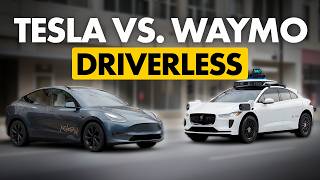
Tesla’s upcoming Cybercab embodies their philosophy: a sleek, purpose-built robotaxi with no steering wheel, no pedals, and no visible sensors. Compare that to Waymo’s Jaguar I-PACE, bristling with equipment that screams “autonomous test vehicle.”
Which would you rather ride in?
Tesla’s 6+ million vehicles have driven billions of miles, encountering edge cases that Waymo’s fleet of thousands will never see at the same rate. In machine learning, data is everything—and Tesla’s data advantage is insurmountable.
Both companies have made impressive progress, but Tesla’s approach is fundamentally more scalable. Lower costs, simpler hardware, better aesthetics, and an unmatched data pipeline. Waymo may have geofenced perfection in a few cities, but Tesla is building something that can work everywhere—because it works the way humans do.
The vision-only bet is paying off. And with Austin operations proving the concept, the future of autonomous driving looks increasingly like a Tesla.
🌐 Visit the Official Site

Taha Salahuddin Abbasi
Engineer. Builder. Architect.
Related videos from The Brown Cowboy
I Tested FSD V14 with Bike Racks... Here is the Truth
Tesla Robotaxi is Finally Here. (No Safety Driver)

